 Call to book
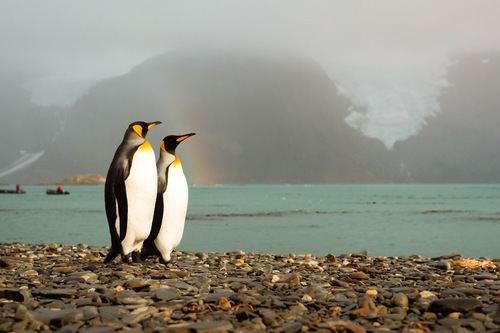
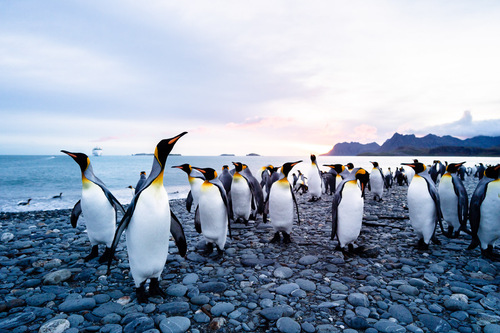
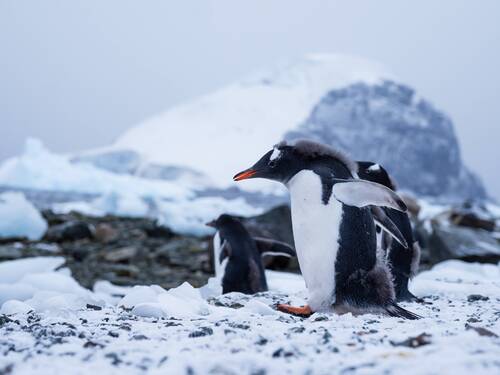
Native to the sub-Antarctic islands, including South Georgia, the Falklands, and the Crozet and Kerguelen archipelagos, the King penguin is the second-largest penguin species, instantly recognisable by its striking orange-yellow ear patches, matching chest blaze, and sleek silver-grey back. Unlike the Adelie and other Antarctic species, King penguins don't breed on the Antarctic continent or build nests, instead favouring ice-free island ground and a unique breeding strategy all their own. These penguins gather in enormous, densely packed colonies, some numbering in the hundreds of thousands, making for one of the most spectacular wildlife sights in the sub-Antarctic.

King Penguins in Gold Harbour
South Georgia | Credit: Michael Baynes

King Penguins
South Georgia | Credit: Lauren Bath
Quick Facts
Scientific Name | Aptenodytes patagonicus |
Length | 85 - 95cm |
Weight | 9.3 - 17.3 kg |
Population | 2,200,000 breeding pairs |
Species Status | Least concern |
Diet and Behaviour
King penguins feed primarily on lanternfish and squid, diving to remarkable depths, often beyond 200 metres and occasionally over 300 metres, in search of prey found near the Antarctic Polar Front. They are powerful, efficient swimmers, capable of spending extended periods at sea on foraging trips that can last more than a week when provisioning chicks. On land, King penguins are highly social and gather in vast, tightly packed colonies, where individuals use distinctive vocal calls to locate their mates and chicks amid the crowds. Their foraging range and diving behaviour are closely tied to the location of nutrient-rich water masses, which can shift with oceanic conditions and influence breeding success from season to season.
Breeding Cycle
The King penguin has one of the longest and most unusual breeding cycles of any penguin species, taking around 14 to 16 months to raise a single chick, meaning most pairs only breed twice every three years. Rather than building a nest, parents balance a single egg on top of their feet, tucked beneath a warm fold of skin called a brood pouch, and both parents take turns incubating it over roughly seven weeks. Once hatched, chicks are similarly kept warm on their parents' feet before growing large enough to gather in crèches for protection while both parents forage at sea. Chicks develop a thick coat of brown down and can take close to a year to fledge, often enduring the harsh sub-Antarctic winter on land before finally heading out to sea.

King Penguins South Georgia Antarctica
South Georgia Antarctica | Credit: Shane Gross
King Penguin FAQs
Do King Penguins live in Antarctica?
Not on the continent itself — they breed on ice-free sub-Antarctic islands and forage in the surrounding Southern Ocean.
What is the best time of year to see King Penguins?
Their breeding cycle spans 14 to 16 months, so colonies are active almost year-round, though austral summer (November to March) offers the easiest access.
Why don't King Penguins build nests?
They balance their single egg on their feet, tucked under a warm fold of skin called a brood pouch, instead of nesting.
Can I see a King Penguin on an Aurora Expeditions voyage?
Yes — South Georgia is the best place to see them, home to some of the world's largest king penguin colonies, visited on our South Georgia voyages.
Featured Antarctic Expeditions