 Call to book
Bearded seals play a vital role in Arctic ecosystems and Indigenous cultures. Ecologically, they help maintain healthy marine food webs by regulating populations of bottom-dwelling invertebrates and fish, and they serve as an important prey species for predators such as polar bears and orcas. Culturally, bearded seals have long been essential to Inuit communities, providing nutritious food and durable hides used for tools, boats, clothing, and footwear. Their presence is also an indicator of sea-ice health, making them a key species for understanding the impacts of climate change on Arctic marine environments.

Quick Ringed Seal Facts
| Scientific name | Erignathus barbatus |
| Length | 21.1 - 2.4m (6-7ft) |
| Weight | 216 - 360kg |
| Species Conservation Status | Least Concern |
Diet and Behaviour
Diet and Behaviour
Bearded seals are solitary, circumpolar Arctic residents most often found near moving pack ice, leads, and polynyas. They stay close to open water when hauled out for rapid escape from predators such as polar bears and orcas. Using their long, sensitive whiskers, they forage on the seafloor in shallow marine areas, feeding primarily on bottom-dwelling invertebrates and fish including crabs, shrimp, clams, and snails. They are capable divers, with feeding dives recorded to depths of up to 220 metres. Adult males produce complex underwater vocalisations during the breeding season, suggesting a sophisticated but poorly understood social structure.
Breeding Cycle
Bearded seals have an annual reproductive cycle with an 11-month gestation period, including delayed implantation. Females give birth on pack ice between mid-March and late April. Pups are able to swim shortly after birth and can dive to escape predators. Nursing lasts only 12–18 days, after which pups moult into their adult coat and become independent. Females are typically ready to breed again within two weeks of weaning.

Bearded Seals FAQs
Where do bearded seals live?
Bearded seals live throughout the Arctic Ocean and surrounding seas, with a circumpolar distribution across the Northern Hemisphere. They are permanent Arctic residents and are most commonly found in regions with moving pack ice, including leads and polynyas where open water is available for breathing and feeding.
Bearded seals depend heavily on sea ice over shallow continental shelf waters, which provide access to their preferred bottom-dwelling prey.
How can I identify a bearded seal?
You can identify a bearded seal by a combination of distinctive physical features and behaviours:
Long, white whiskers: Their most recognizable trait — thick, bushy vibrissae that give the seal its “bearded” appearance.
Broad, square muzzle: A large, wide snout that contrasts with their small, close-set eyes.
Large, robust body: One of the bigger Arctic seal species, with a thick, heavy build.
Uniform coat colour: Grey to brown fur with no bold markings, darker on the back and lighter underneath.
Flippers: Broad foreflippers with strong claws, useful for maintaining breathing holes in ice.
Beaded Seals are often seen alone, hauled out near the edge of pack ice, and known for producing distinctive underwater “singing” during the breeding season.
What makes bearded seals different from other Arctic seals?
Bearded seals are noticeably larger and heavier, with a broader, square-shaped muzzle and much longer, bushier white whiskers than species such as ringed, harp, or ribbon seals. They also lack the bold patterns or spots seen on many other Arctic seals.
Unlike most seals, males produce complex underwater songs during the breeding season, and females have four teats with a very short nursing period. Bearded seals are typically solitary, setting them apart from more social Arctic seal species.
Are bearded seals endangered?
The species is listed as Near Threatened on the IUCN Red List, indicating it has moved closer to being at risk, the main cause being climate change. Bearded seals rely heavily on stable sea ice for:
- Birthing and nursing pups
- Molting
- Resting between feeding dives
As Arctic ice melts earlier and forms later each year, these critical life stages are disrupted.
Featured Arctic Expeditions

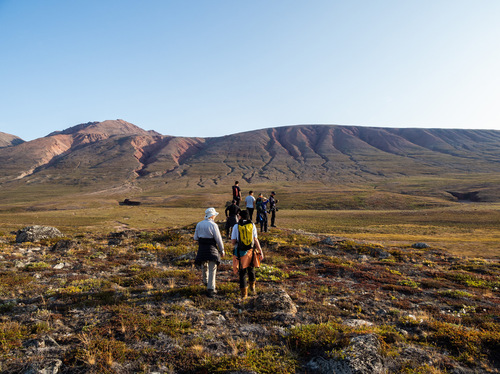

Polar Expedition
Arctic
Jewels of the Arctic
Duration
15 Days
2027 Season
Jul, Aug
2028 Season
Jul, Aug
From USD
$19,356
$24,195
per person
twin share