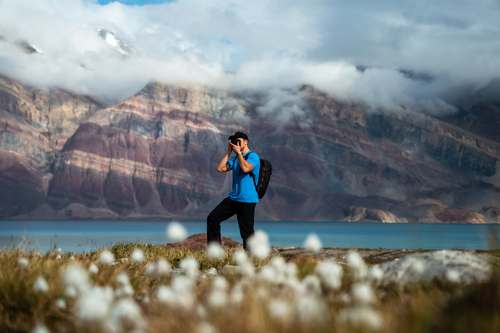
Q&A with Sandra Magnus | NASA Astronaut and Aerospace Engineer
Joining our Jewels of the Arctic: Greenland Solar Eclipse voyage in August 2026, we spoke to NASA Astronaut and Aerospace Engineer Sandra Magnus
On 12 August 2026, I will be aboard Aurora Expeditions’ purpose-built small expedition ship, the Greg Mortimer, off East Greenland, waiting for the Moon to pass between Earth and the Sun.
For approximately two minutes and 18 seconds, we expect the Sun to be completely obscured by the Moon. Daylight will fade, the landscape will darken and the Sun’s outer atmosphere—the corona—will become visible.
I have previously seen the Moon’s shadow sweep across Earth while living aboard the International Space Station. This time, after spending more than 157 days in space across four spaceflights, I will experience a total solar eclipse from within the shadow itself.
As a Special Guest on Aurora Expeditions’ Jewels of the Arctic: Greenland Solar Eclipse voyage, I look forward to sharing the science behind the event with expeditioners. But when totality arrives, my advice is simple: understand the mechanics beforehand, then put them in the back of your mind and experience the wonder of the moment.

How does a total solar eclipse work—and why is totality so rare?
A solar eclipse occurs when the Moon passes between Earth and the Sun, blocking some or all of the Sun’s light and casting a shadow across part of our planet.
A total solar eclipse occurs when the Moon completely covers the visible surface of the Sun for people positioned within the darkest part of its shadow, known as the umbra.
Although the Sun is vastly larger than the Moon, it is also much farther away. From Earth, they appear to be almost the same size in the sky. When their alignment is precise, the Moon can briefly cover the Sun.
The Moon’s full shadow reaches only a relatively small area of Earth. As the Moon and Earth continue moving, that shadow traces a narrow corridor known as the path of totality.
People within this path see the Sun become completely obscured. Those outside it experience a partial solar eclipse, during which only part of the Sun is covered.
Partial eclipses are much more common to witness. To experience totality, you need to be in precisely the right place at the right time.
What is special about the August 2026 total solar eclipse?
The total solar eclipse on 12 August 2026 will cross parts of Greenland, Iceland, Spain and Portugal, while much of Europe will experience a partial eclipse.
Aurora Expeditions’ dedicated solar eclipse voyage has been designed to position the Greg Mortimer within the path of totality off East Greenland, one of the limited regions where the Sun will be completely obscured.
From our anticipated viewing region, totality is expected to last approximately two minutes and 18 seconds.
That may sound brief, but the transformation during totality is unlike an ordinary sunset—or even a deep partial eclipse.
We will also be aboard a small expedition ship in the ocean, away from many of the crowds expected at more accessible viewing locations. I am particularly looking forward to sharing this remote and intimate experience with a relatively small group of expeditioners.
What happens as totality approaches?
A solar eclipse unfolds gradually as the Moon moves across the face of the Sun.
At first, it may appear that a small section has been taken from the Sun’s edge. As more of the Sun is covered, the quality of the light changes. Colours can appear muted, shadows become sharper and temperatures may begin to fall.
The sky gradually darkens, resembling dusk, and birds or other wildlife may respond as though evening has arrived unexpectedly.
Immediately before totality, the remaining sunlight may appear as brilliant points shining through valleys along the Moon’s edge. These are known as Baily’s Beads.
As the final point of direct sunlight disappears, viewers may see the diamond-ring effect. Then totality begins.
When the Moon completely covers the Sun’s bright surface, the sky darkens dramatically. Bright planets and stars may become visible, while the Sun’s corona appears around the Moon’s dark outline.
The corona is the outermost part of the Sun’s atmosphere. It is always present, but normally hidden by the intense brightness of the Sun’s visible surface.
This is why 90% or even 99% coverage is fundamentally different from totality. The remaining sliver of sunlight is still bright enough to illuminate the sky and conceal the corona. Only when the Sun is completely covered does the full transformation occur.
What can scientists learn from a solar eclipse?
A total solar eclipse provides scientists with a valuable opportunity to study the Sun’s corona, structure, atmosphere and magnetic activity.
Because the Moon temporarily blocks the bright surface of the Sun, details within the corona become easier to observe. These studies contribute to our understanding of solar activity and processes that may affect satellites, communications systems and power infrastructure on Earth.
Researchers can also examine how the sudden reduction in sunlight affects temperatures, wildlife and Earth’s upper atmosphere.
An eclipse may last only minutes, but the observations gathered can contribute to much broader scientific research.

What does a solar eclipse look like from space?
From Earth, we watch the Moon move across the Sun. From orbit, it is possible to see a different part of the event: the Moon’s shadow sweeping across the planet below.
I witnessed this during an eclipse in January 2009 while serving as a flight engineer and science officer aboard the International Space Station.
From space, the shadow appears as a dark area moving across Earth’s surface. You see the geographical scale of the eclipse and the path created by the precise movement of the Sun, Moon and Earth.
In August, I will experience that same phenomenon from the opposite perspective—not looking down at the shadow, but standing within it.
How can people safely watch and experience totality?
Eye safety is essential during any solar eclipse.
During the partial phases before and after totality, viewers must use approved eclipse glasses or a proper handheld solar viewer. Ordinary sunglasses are not safe, regardless of how dark they appear.
Cameras, binoculars and telescopes must have specially designed solar filters fitted securely over the front. Looking through unfiltered optical equipment can cause severe eye injury.
Only during the brief period of totality, when the Sun is completely covered by the Moon, is it safe to look without approved eye protection. As soon as even a small part of the Sun begins to reappear, eclipse glasses must go back on.
Anyone outside the path of totality must use approved eye protection throughout the entire eclipse.
Preparation matters, but once totality begins, remember to look beyond the Sun. Notice the changing light, the temperature, the surrounding landscape and the reactions of the people beside you.
Then put the mechanics into the back of your mind and simply experience the magic and wonder of the event.
Planning to bring a camera? [Check out our tips for photographing a total solar eclipse → Solar Eclipse Photography: How to Photograph a Solar Eclipse] to make sure you're prepared before totality arrives.
Why do eclipses change our perspective?
Before humans understood orbital mechanics and the movement of the planets, the sudden disappearance of the Sun must have been incredibly frightening.
Even now, when we understand precisely why it is happening and can predict it years in advance, totality can feel eerie.
Daylight disappears unexpectedly. Temperatures fall. The landscape changes. The familiar Sun becomes a dark circle surrounded by its glowing atmosphere.
It is a powerful reminder that the universe is vast and shaped by forces beyond our everyday experience. During an eclipse, we briefly feel our connection to that larger system.
Living and working aboard the International Space Station for four and a half months gave me a similar shift in perspective.
Viewing Earth from orbit—being physically separate from it and looking down—allows you to see it not simply as a collection of countries and landscapes, but as a planet.
The vivid blue, green and white colours reflect the abundant life on Earth. They stand in contrast to the other planets in our solar system, which do not display the same visible richness and diversity.
From orbit, national borders disappear. You see one interconnected planet surrounded by the thin layer of its atmosphere.
That view makes you appreciate Earth and not take it for granted. You realise what a special place it is, understand that it is our shared home and recognise that we must take care of it.
A total solar eclipse creates a different but related shift in perspective. For a few moments, Earth’s place within a much larger celestial system becomes directly visible.
Aurora Expeditions’ Jewels of the Arctic: Greenland Solar Eclipse voyage departs on 2 August 2026 aboard the Greg Mortimer, with former NASA astronaut and aerospace engineer Dr Sandra Magnus joining as a Special Guest.