 Call to book
Humpback Whales in Antarctica: What to Know and Where to See Them
Few wildlife encounters in Antarctica match the spectacle of a humpback whale. These are the performers of the polar ocean — breaching, tail-slapping and spy-hopping with a drama and curiosity that stops every conversation on deck. Seen along the Antarctic Peninsula, gathering in impressive numbers around South Georgia, or feeding in the remote Ross Sea, humpbacks are among the most reliably encountered and endlessly watchable of the great whales.
Appearance
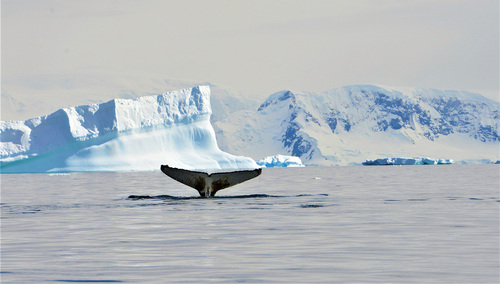
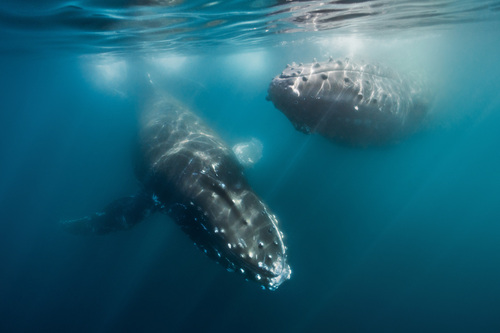
The humpback is instantly recognisable: a spindle-shaped body, extraordinarily long flippers — the longest of any whale relative to body size — and a pronounced hump before a small, curved dorsal fin. Coloration is dark grey to black above and white below, with the rostrum covered in raised tubercles, each housing a single sensory hair. The underside of each tail fluke carries a unique black-and-white pattern, as individual as a fingerprint, which researchers use to identify whales across seasons. Before a deep dive, a humpback arches its back and raises its flukes clear of the water — often the most photographed moment of any whale encounter. The blow is bushy and mushroom-shaped, reaching four to five metres.
Quick Facts
Scientific name | Megaptera novaeangliae |
Length | Up to 18m (60 ft) |
Weight | Up to 40 tonnes |
Population | ~140,000 individuals |
Species status | Least Concern |
Diet and Behaviour
Humpbacks feed almost exclusively on Antarctic krill in polar waters, consuming up to one and a half tonnes a day during peak summer. Their standout technique is bubble-netting: working in coordinated groups, whales dive beneath prey and release a rising spiral of bubbles that corrals krill or fish into a tight ball near the surface, before surging upward together with mouths open — one of the most breathtaking sights in wildlife. Humpbacks are also the most acrobatic of the great whales, known for full breaches, pec-slaps and lobtailing.
Breeding
Humpbacks undertake some of the longest migrations of any mammal, travelling from polar feeding grounds in summer to tropical breeding grounds in winter. Males compete for females through complex songs that can carry for hundreds of kilometres. Females give birth to a single calf after an 11–12 month gestation, nursing for about a year, and typically calve every two to three years. Humpbacks live 45–50 years, with some individuals reaching over 60.

Humpback Whale
Foyne Harbour, Antarctica | Credit: Tyson Mayr

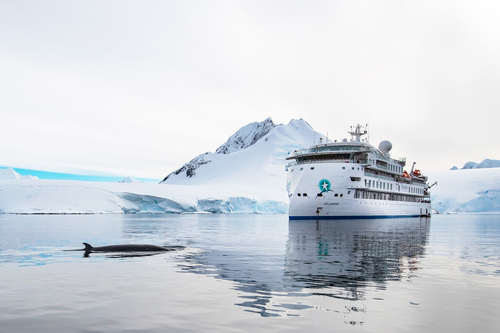
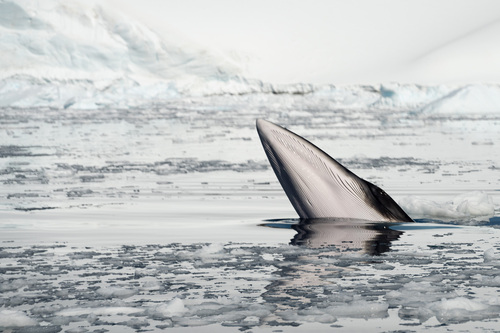
Humpback Whale
Fournier Harbour, Antarctica | Credit: Rachelle Mackintosh
Where and When to See Them
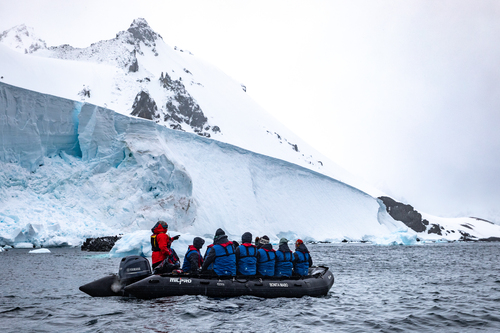
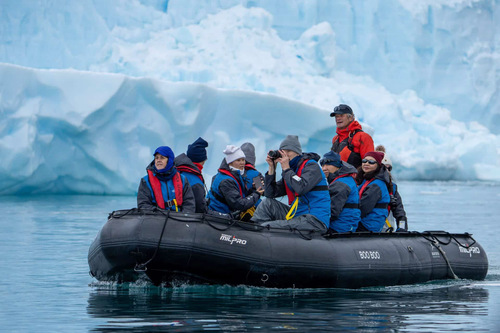
Humpbacks arrive in Antarctic waters from November as sea ice retreats and krill blooms. The Antarctic Peninsula offers the most accessible encounters, with whales gathering in outstanding numbers from December through March — Zodiac cruises often bring expeditioners within close range of feeding and bubble-netting groups. South Georgia is a particular highlight for sheer concentration of whales, while the Ross Sea and East Antarctica offer reliable sightings further south. Naturally inquisitive, humpbacks will often approach vessels and Zodiacs directly.
Humpback Whale FAQs
How big do humpback whales get?
Up to 18 metres and 40 tonnes, with females generally larger than males.
What do they eat in Antarctica?
Almost exclusively Antarctic krill — up to one and a half tonnes a day during the summer feeding season.
What is bubble-netting?
A cooperative feeding technique where whales release spiralling bubble columns to herd prey into a ball before lunging through it together, mouths open.
How can you identify a humpback?
By the unique black-and-white pattern on the underside of its tail fluke, along with its hump, long white flippers and bushy, mushroom-shaped blow.
Best time to see them?
December through March, coinciding with the peak of Aurora Expeditions' Antarctic voyage season.
Which Aurora Expeditions voyages offer the best chance?
Antarctic Peninsula voyages, where bubble-netting is a Zodiac cruising highlight, plus South Georgia & Antarctic Peninsula, Ross Sea & East Antarctica, and Spirit of Antarctica: Whale Migration.
Find Your Expedition