Penguins in Antarctica
Few animals are as closely associated with the polar regions as penguins. From vast coastal colonies to solitary figures standing against the ice, penguins in Antarctica are one of the continent’s most captivating sights. Perfectly adapted to life in extreme cold and turbulent seas, these birds play a vital role in Antarctic ecosystems and have fascinated explorers, scientists and travellers for centuries.
In this guide, we explore what kind of penguins live in Antarctica, how many species are found there and why these birds are so important to the frozen continent they call home.
Do Penguins Live in Antarctica?
Yes, penguins do live in Antarctica. Several penguin species breed on the Antarctic continent and surrounding sub‑Antarctic islands, relying on the cold Southern Ocean for food and the region’s sea ice and coastlines for nesting and raising chicks.
Why Penguins Only Live in Antarctica
Penguins are uniquely suited to Antarctica’s harsh conditions. Their dense, waterproof feathers, thick layers of blubber and streamlined bodies allow them to thrive where few other animals can. The surrounding Southern Ocean is rich in krill, fish and squid, providing an abundant food source that supports large penguin populations.
Unlike the Arctic, where polar bears dominate, Antarctica evolved without land predators. This allowed penguins to flourish as ground‑nesting seabirds, developing behaviours and breeding strategies shaped by ice, wind and ocean rather than threats on land.
Read more about Why There are No Penguins in the Arctic.

How Many Species of Penguins Live in Antarctica?
Globally, there are 18 recognised species of penguins, all found in the Southern Hemisphere. A smaller group of these species is closely associated with Antarctica and the surrounding Southern Ocean.
When asking how many species of penguins live in Antarctica, it helps to consider both penguins that breed on the continent itself and those that nest on nearby Antarctic and sub‑Antarctic islands.
This can be broken down as follows:
- Four species breed on the Antarctic continent itself
- Four additional species breed on surroundingAntarctic and sub‑Antarctic islands, including regions such as South Georgia and other islands commonly visited on routes to Antarctica
Types of Penguins in Antarctica
Below is an overview of the different types of penguins in Antarctica, including sub‑Antarctic species. Together, these species make up the penguins regularly encountered across Antarctic expedition routes.
Emperor Penguin
Emperor penguins are the largest of all penguins, standing around 1.1–1.3 metres tall (3 ft 7 in–4 ft 3 in) and are found exclusively in Antarctica. They are the only penguin species to breed during the Antarctic winter, relying on stable sea ice to raise their chicks. Feeding on squid and fish, Emperor penguins are extraordinary divers, capable of plunging more than 500 metres (1640 ft) deep and holding their breath for over 20 minutes.
Adélie Penguin
Adélie penguins are small, energetic birds found along much of Antarctica’s coastline and nearby islands. Easily recognised by their white eye rings, they are known for their bold, curious personalities. As one of the most widespread Antarctic penguin species, Adélies are highly social and nest in dense penguin colonies feeding primarily on krill. They’re also infamous pebble thieves, often stealing stones from neighbouring nests to build their own.
Chinstrap Penguin
Easily recognised by the thin black line beneath their chin, Chinstrap penguins breed on the Antarctic Peninsula and nearby islands. They prefer steep, rocky nesting sites and rely heavily on krill. Chinstrap penguins are strong swimmers and agile climbers, often moving across terrain that appears surprisingly rugged.
Gentoo Penguin
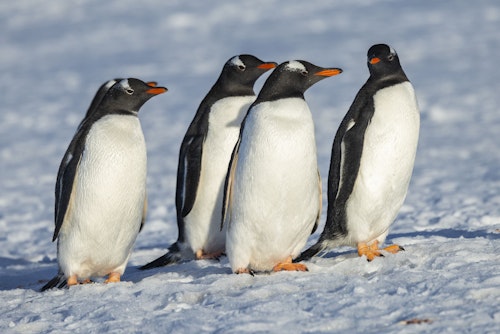
Gentoo penguins are highly adaptable and are the fastest swimmers of all penguin species, reaching speeds of up to 36 km/h (22 mph). Easily identified by their bright orange bills and distinctive white head stripe, they breed on the Antarctic Peninsula and nearby islands, favouring ice‑free coastal areas. Gentoo penguins feed on a varied diet of krill, fish and squid, which helps them thrive across a range of Antarctic environments.
Rockhopper Penguins
Rockhopper penguins are small, energetic birds named for their habit of hopping across steep, rocky terrain. They are easily recognised by their striking yellow eyebrow feathers and bright red eyes. Rockhopper penguins breed on sub‑Antarctic islands. Despite their size, they are strong swimmers and resilient survivors of harsh coastal environments.
King Penguin (Sub‑Antarctic)
Often confused with emperors, King penguins are slightly smaller and slender, standing around 85 - 95 cm (33 – 37 inches). They are a sub‑Antarctic species, breeding on islands such as South Georgia rather than the Antarctic continent itself. However, they are closely associated with Antarctic waters and are commonly encountered on voyages to South Georgia. King penguins form some of the largest breeding pairs and colonies in the world and feed primarily on fish and squid from deep, open waters.
Macaroni Penguin (Sub‑Antarctic)
Macaroni penguins are famous for their bold yellow feather crests and are often mistaken for Rockhopper penguins at first glance. While both species have yellow head plumes, Macaroni penguins are noticeably larger and have fuller, more pronounced crests that extend along the sides of the head. They breed mainly on sub‑Antarctic islands and are among the most numerous penguin species in the world, forming vast colonies across regions linked to Antarctica’s wider ecosystem.
Magellanic Penguins
Magellanic penguins are a temperate species found along the southern coast of South America. While they do not live in Antarctica, they are part of the broader Southern Hemisphere penguin family and are sometimes encountered on voyages through southern South American waters en route to Antarctica.
Life in the Antarctic Environment
Breeding and Colonies
Most Antarctic penguins rely on predictable seasonal cycles. Breeding pairs gather in colonies during the austral summer, typically between October to March, using ice‑free ground or stable sea ice to lay eggs and raise chicks. Timing is critical as chicks must mature before winter conditions return.
Food and Predators
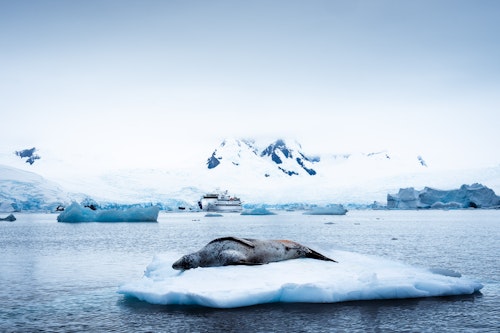
Antarctic penguins feed primarily on krill, squid and fish. At sea, they face predators such as Leopard Seals, which pose a significant threat near shorelines and ice edges. Underwater speed and agility are essential for survival across several species, with some penguins capable of rapid bursts of swimming speed. Gentoo penguins, for example, are among the fastest, reaching speeds of up to 36 km/h (22 mph).
Endangered Penguins in Antarctica
While penguins are superbly adapted, not all species are safe. Climate change is altering Antarctic sea ice, affecting food availability and breeding success across multiple species.
As of the writing of this article in 2026, Emperor penguins have recently been classified as an endangered species in Antarctica, due to declining sea ice stability. As sea ice forms later and breaks up earlier, chicks are increasingly exposed before they are ready to survive independently.
Why Penguins Matters in Antarctica
Penguins depend on healthy oceans, abundant krill, stable sea ice and balanced food chains. When these systems change, penguins are often among the first species to be affected. Because penguins sit near the top of the Antarctic marine food web, shifts in their populations can reveal broader changes in sea ice conditions, prey availability and ocean temperatures.
For this reason, penguins play an important role in Antarctic science and long‑term monitoring. Conservation efforts help scientists track population trends, protect critical breeding habitats, regulate fisheries and better understand how climate change is reshaping Antarctica.
On expeditions, penguins are frequently included in Citizen Science projects, where individual birds and entire colonies are counted, photographed and carefully observed. These shared observations contribute to long‑term data collection across the polar regions and support informed conservation planning for Antarctica’s future.
Penguins in Antarctica FAQs
Do penguins live in Antarctica?
Yes. Several penguin species breed on the Antarctic continent and in nearby sub‑Antarctic regions.
Are penguins found in the Arctic or Antarctic?
Penguins are found in the Southern Hemisphere, including Antarctica, but not in the Arctic.
What kind of penguins live in Antarctica?
Emperor, Adélie, Chinstrap and Gentoo penguins breed on the Antarctic continent, while King, Macaroni and Rockhopper penguins breed on nearby sub‑Antarctic islands.
Why do penguins only live in the Antarctic?
Penguins evolved in the Southern Hemisphere where the cold conditions, an absence of land-based predators and abundant food supplies of krill, fish and squid allowed them to thrive.
How many species of penguins live in Antarctica?
Seven penguin species are associated with Antarctica and nearby islands, but only four species breed on the Antarctic continent itself.
What are the types of penguins in Antarctica?
Emperor, Adélie, Chinstrap, and Gentoo penguins breed on the Antarctic continent itself.
King, Macaroni, and Rockhopper penguins do not breed on the continent but are closely associated with Antarctica, nesting on nearby sub‑Antarctic islands such as South Georgia and other islands within the Southern Ocean.