 Call to book
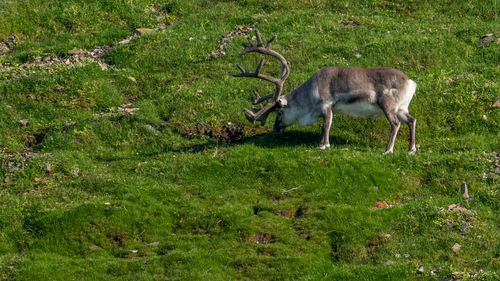
Reindeer, known as caribou in North America, are members of the species Rangifer tarandus and comprise 6–8 extant subspecies, including the unique Svalbard reindeer. They are widespread across the Arctic, from boreal forests to the northernmost barren lands, and are the most abundant large animals in the region. Reindeer have been closely linked to human cultures for over 3,000 years, particularly in northern Eurasia, where they are domesticated for milk, meat, hides, and as beasts of burden. Large and sexually dimorphic, males are significantly bigger than females. Their dense, woolly coats vary from brown to olive with whitish underparts, and their broad, cleft hooves allow efficient movement over snow and tundra. Reindeer are herbivorous, feeding on a wide variety of vegetation including leaves, lichens, and twigs. Most populations are migratory, traveling seasonally between wintering grounds in the boreal forest and calving grounds in the high Arctic, with distances sometimes reaching 1,000 kilometres. They are the only deer species in which both males and females grow antlers, although their size and timing differ between the sexes.

Svalbard Reindeer Facts
| Scientific name | Rangifer tarandus platyrhynchus |
| Length | 150–220 cm (nose to tail) |
| Male Weight | 53–90 kg |
| Female Weight | 41–60 kg |
| Population | 6,500–7,000 individuals |
| Species Conservation Status | Least Concern |
Diet and Behaviour
Svalbard reindeer are non-migratory and display sedentary behaviour that helps them conserve energy in the extreme Arctic environment. Unlike most reindeer populations, they cannot migrate into sheltered boreal forests and instead remain year-round on exposed mountain ridges and plateaus where snow accumulation is low. Their diet consists entirely of vegetation, especially short-growing lichens and other hardy plants that remain accessible during winter. Their broad, splayed hooves allow them to move efficiently over snow and soft tundra while foraging. By remaining in limited areas and feeding on available low-growing plants, Svalbard reindeer are well adapted to survive long, harsh winters with minimal movement and energy expenditure.
Breeding Cycle
The Svalbard reindeer follows a seasonal pattern adapted to the Arctic environment. Mating occurs in October during the rut, when males compete for access to females using their antlers. After mating, females experience a gestation period of about 227–229 days. Calves are then born in late spring or early summer (usually in May or June), this is when conditions are more favourable as food becomes available. Each female gives birth to a single calf, which is able to stand and follow its mother within an hour of birth. The calf nurses exclusively for about one month and continues to suckle occasionally until winter. Females retain their antlers through winter to defend themselves and their calves, shedding them after the young are weaned, before growing new antlers for the next breeding season.

Credit: Adrian Wlodarczyk

Credit: Fiona Wardle
Svalbard Reindeer FAQs
What's the difference between a reindeer vs a svalbard reindeer?
The Svalbard reindeer is smaller and stockier, which help conserve heat, protecting them from the extreme Arctic conditions. Unlike most mainland reindeer, which are large and migratory, Svalbard reindeer are largely sedentary, remaining year-round on exposed mountain ridges and plateaus. They feed primarily on short-growing lichens and hardy Arctic vegetation, and both sexes grow antlers, with females retaining theirs through winter to protect themselves and their calves. Their compact bodies, thick underfur, and shorter legs help conserve heat and energy in the harsh environment. These adaptations make Svalbard reindeer distinct from their larger, migratory mainland relatives, which occupy a wider range of Arctic and sub-Arctic habitats.
Are Svalbard reindeers endangered?
No, they are classified as least concern by the IUCN. They are stable and not currently under any major treat. Their remote Arctic habitat offers some protection, though they remain vulnerable to climate change and human disturbance.
What is the average lifespan of the Svalbard reindeer?
Svalbard reindeers live for an average of 10 years.
The common cause of death is starvation, cause by the harsh winters, limited food and worn down teeth. However, some have been noted for living as long as 17 years.
Featured Arctic Expeditions
Polar Expedition
Arctic
Spitsbergen: Realm of Ice & Wildlife
Duration
8 Days
2027 Season
Aug
2028 Season
Jun, Jul
From EUR
€10,196
€13,595
per person
twin share